Introduction to Water Jet Loom Machines
In the dynamic world of textile manufacturing, the quest for higher productivity, superior fabric quality, and cost efficiency is relentless. Among the various weaving technologies, Water Jet Loom machines have emerged as a cornerstone for modern textile mills, particularly in regions like Surat, Gujarat. These high-speed weaving machines leverage the power of water to insert weft yarns, offering distinct advantages for specific fabric types. For textile mill owners, weaving managers, and engineers, understanding the intricacies of water jet looms is crucial for making informed decisions to optimize production and stay competitive.
This detailed guide from EMS Textiles will explore the working principle, advantages, applications, and comparative aspects of water jet loom machines, highlighting how this technology drives productivity and quality in contemporary textile production.
The Ingenious Working Principle of Water Jet Weaving
At its core, water jet weaving is a marvel of engineering that uses a fine, high-pressure jet of water to carry the weft yarn across the warp shed. This method offers a remarkably efficient and precise way to interlace yarns.
How Water Jet Looms Work
The process begins with the formation of the shed, where warp yarns are separated to create an opening. Simultaneously, a pre-measured length of weft yarn is prepared. The heart of the system is the water pump, which generates a powerful, fine jet of water. This jet is then directed through a precision nozzle, picking up the weft yarn and carrying it swiftly through the shed from one side to the other. Once the weft yarn is inserted, the water jet dissipates, and a beating-up mechanism pushes the newly inserted weft yarn firmly against the already woven fabric, consolidating the weave. Finally, the woven fabric is wound onto a take-up roller, while fresh warp yarns are fed from the let-off motion, ensuring a continuous weaving process.
Key Components of a Water Jet Loom
- Weft Insertion System: Comprises a high-pressure pump, a precise nozzle, and a weft accumulator that measures and prepares the yarn.
- Shedding Mechanism: Typically cam or dobby mechanisms create the opening for weft insertion.
- Beat-up Mechanism: A reed, driven by cranks, pushes the weft into position.
- Take-up Motion: System that winds the woven fabric onto a cloth roll at a controlled rate.
- Let-off Motion: System that feeds warp yarns from the warp beam at a uniform tension.
- Water Circulation and Filtration System: Essential for maintaining water purity and ensuring consistent jet quality, reducing nozzle wear.
Advantages of Water Jet Loom Machines in Modern Textile Production
The widespread adoption of water jet looms stems from their significant advantages, particularly for specific fabric types and production goals.
- High Speed & Productivity: Water jet looms are renowned for their exceptional weft insertion rates, making them one of the fastest weaving machines available. This translates directly to higher fabric output and improved factory productivity.
- Superior Fabric Quality: The gentle and uniform propulsion of weft yarn by water reduces yarn stress and breakage, resulting in fewer weaving defects. The consistent weft insertion ensures a cleaner, more uniform fabric surface.
- Reduced Noise & Vibration: Compared to mechanical shuttle or rapier looms, water jet looms operate with considerably less noise and vibration, contributing to a better working environment for operators.
- Energy Efficiency (for suitable fabrics): While the pump requires power, for specific synthetic, hydrophobic fabrics, the overall energy consumption can be competitive, especially when considering the high output.
- Versatility with Synthetic Yarns: They excel at weaving synthetic, hydrophobic yarns like polyester, nylon, and polypropylene, which do not absorb water, making them ideal for technical textiles, sportswear, and lining fabrics.
- Lower Production Costs: High speed and reduced yarn breakage contribute to lower labor costs per meter of fabric and less raw material waste, improving overall profitability.
Applications and Fabric Compatibility
Water jet looms are specialized machines, best suited for weaving fabrics from synthetic filaments due to the nature of their weft insertion. The hydrophobic properties of these yarns prevent them from absorbing water during the weaving process, which is critical for maintaining yarn integrity and fabric quality.
Common Applications:
- Lining Fabrics: Polyester and nylon linings for garments.
- Sportswear: Performance fabrics for athletic wear, known for durability and quick-drying properties.
- Industrial Fabrics: Geotextiles, filter cloths, and other technical textiles where high strength and consistent quality are paramount.
- Outerwear: Materials for jackets, raincoats, and windbreakers.
- Medical Textiles: Certain non-absorbent medical fabrics.
- Curtains and Home Furnishings: Specific types of drapery and upholstery made from synthetic fibers.
Water Jet Loom vs. Air Jet vs. Rapier: A Comparative Analysis
Choosing the right loom technology is a critical decision for any textile mill. Here's a comparison to help you understand where water jet looms stand against their common counterparts: Air Jet and Rapier looms.
| Feature | Water Jet Loom | Air Jet Loom | Rapier Loom |
|---|---|---|---|
| Weft Insertion | High-pressure water jet | High-pressure air jet | Rigid or flexible rapiers |
| Speed (RPM/PPM) | Very High (1000-1500+ RPM) | Extremely High (1200-2000+ RPM) | Moderate to High (400-800 RPM) |
| Efficiency | High, especially for synthetics | Very high, for diverse yarns | High, very versatile |
| Operating Cost | Moderate (Water treatment, power for pump) | High (High air compression costs) | Moderate (Mechanical wear) |
| Fabric Suitability | Best for Synthetic, Hydrophobic filament yarns (e.g., polyester, nylon) | Wide range, especially staple yarns (cotton, denim, synthetic blends) | Most versatile, good for complex weaves, heavy yarns, delicate yarns, wool, silk |
| Fabric Width | Typically narrower to medium | Medium to very wide | Medium to very wide |
| Noise Level | Low to Moderate | Moderate to High | Moderate to High |
| Initial Investment | Moderate | High | Moderate to High |
| Maintenance | Focus on water system, nozzles | Focus on air nozzles, valves, compressor | Focus on mechanical parts, grippers |
While water jet looms offer unparalleled speed for specific applications, air jet looms generally provide the highest speed across a wider range of fabrics, albeit with higher energy consumption for air compression. Rapier looms, though slower, offer unmatched versatility for complex weaves and a vast array of yarn types.
Limitations and Maintenance Requirements
Despite their advantages, water jet looms have specific limitations and demand diligent maintenance.
Key Limitations
- Fabric Type Restriction: The most significant limitation is their suitability primarily for synthetic, hydrophobic filament yarns. Natural fibers like cotton or rayon would absorb water, leading to yarn swelling, tangling, and fabric damage.
- Water Management: Requires a robust water filtration and recycling system to ensure clean water, prevent clogging, and minimize water wastage.
- Initial Investment: While not as high as some advanced air jet looms, the initial cost combined with water treatment infrastructure can be substantial.
Essential Maintenance Practices for Water Jet Looms
Proper maintenance is crucial for maximizing uptime and extending the lifespan of your water jet looms. A systematic approach, coupled with modern monitoring solutions, can significantly reduce unexpected breakdowns.
- Regular Cleaning: Daily cleaning of the loom area, especially around the nozzles and take-up rollers, to prevent lint and dust accumulation.
- Nozzle Inspection: Frequent inspection and cleaning of weft insertion nozzles to ensure consistent water jet quality and prevent clogging. Replace worn nozzles promptly.
- Water System Check: Regular checks of the water pump, filters, and circulation system. Ensure water quality parameters (pH, hardness) are maintained as recommended.
- Lubrication: Adhering to the manufacturer's lubrication schedule for all moving mechanical parts to minimize friction and wear.
- Electrical System Check: Periodical inspection of electrical connections, sensors, and control panels to prevent malfunctions.
- Software Monitoring (EMS Textiles): Implement a loom monitoring system from EMS Textiles to track machine performance, identify anomalies, and schedule predictive maintenance based on real-time data, preventing costly breakdowns.
Recent Technological Advancements and Boosting Productivity with EMS Textiles
Modern water jet looms are far more sophisticated than their predecessors. Recent advancements focus on enhanced automation, energy efficiency, and data integration.
Manufacturers are now incorporating smart sensors for real-time monitoring of tension, weft insertion timing, and water pressure. IoT (Internet of Things) integration allows these machines to connect to centralized systems, providing comprehensive data for analysis and optimization. Improved pump designs and nozzle technologies further enhance water efficiency and reduce power consumption.
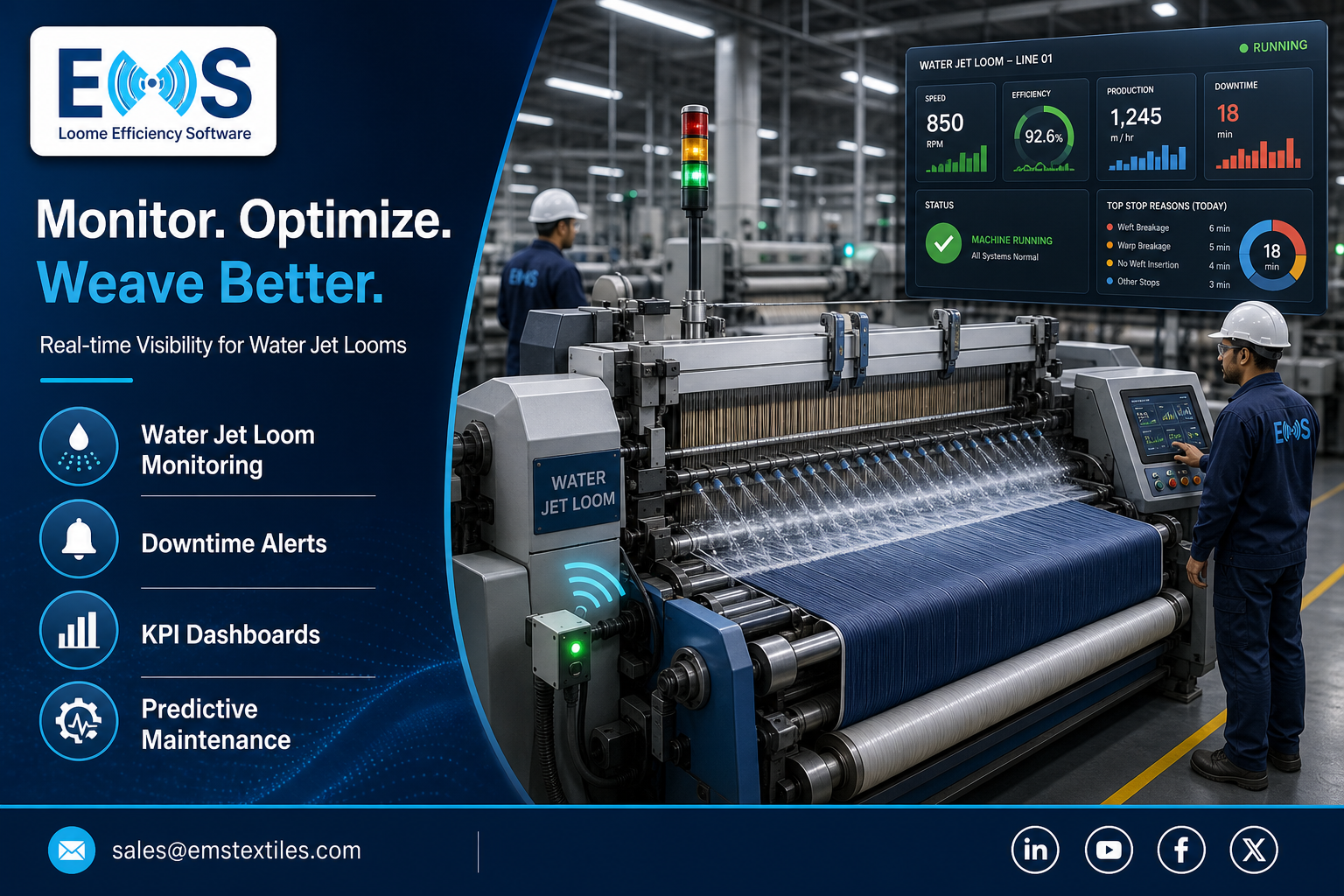
This is where EMS Textiles plays a pivotal role. Our advanced loom monitoring and efficiency software is designed to integrate seamlessly with modern water jet looms, providing textile manufacturers with unprecedented control and insight. By capturing real-time data on parameters such as machine runtime, downtime reasons, production speed, and Efficiency (Overall Equipment Effectiveness), EMS Textiles software empowers you to:
- Identify Bottlenecks: Pinpoint exactly where efficiency is being lost.
- Optimize Settings: Fine-tune loom parameters for maximum output and quality.
- Predictive Maintenance: Shift from reactive repairs to proactive, scheduled maintenance, significantly reducing costly downtime. For water jet looms, monitoring pump performance or nozzle pressure variations can indicate when maintenance is needed before a complete failure.
- Improve Fabric Quality: Consistent monitoring helps maintain optimal weaving conditions, leading to fewer defects and higher-grade fabrics.
- Reduce Waste: By minimizing defects and optimizing processes, you significantly cut down on raw material and energy waste.
With EMS Textiles, you don't just run your water jet looms; you master them, ensuring they operate at peak performance, contributing directly to your factory's profitability and competitive edge.
Frequently Asked Questions (FAQs)
Q1: What makes Water Jet Looms faster than other loom types?
Water jet looms are exceptionally fast primarily because water is a very light and incompressible medium, allowing for extremely rapid weft insertion with minimal inertia. The continuous flow of water also provides consistent propulsion, reducing the mechanical complexity often found in air jet or rapier systems that involve more moving parts for weft gripping or air nozzle control.
Q2: Can natural fibers like cotton or wool be woven on a Water Jet Loom?
No, water jet looms are generally not suitable for natural fibers like cotton, wool, linen, or rayon. These fibers are hydrophilic, meaning they absorb water, which would cause them to swell, lose strength, and tangle during the weaving process, leading to severe yarn breakage and fabric damage. Water jet looms are exclusively designed for hydrophobic synthetic filament yarns.
Q3: What are the main cost considerations when investing in Water Jet Looms?
Key cost considerations include the initial purchase price of the machines, which is moderate compared to very high-end air jet looms. Additionally, you must factor in the cost of a sophisticated water filtration and recycling system, which is crucial for operational efficiency and environmental compliance. Ongoing costs include electricity for the water pumps, maintenance of the water system, and replacement of nozzles.
Q4: How does EMS Textiles improve Water Jet Loom performance?
EMS Textiles' loom monitoring software provides real-time data on every aspect of your water jet loom's operation, including speed, efficiency, downtime, and specific fault reasons. This data allows weaving managers to identify inefficiencies, implement targeted improvements, schedule predictive maintenance for critical components like pumps and nozzles, and ultimately boost Efficiency (Overall Equipment Effectiveness) and fabric quality. Our solutions empower data-driven decisions for maximum productivity.
Conclusion: Powering the Future of Weaving with Water Jet Technology
Water Jet Loom machines represent a powerful, high-speed solution for modern textile manufacturers dealing with synthetic filament yarns. Their ability to deliver exceptional productivity and fabric quality, coupled with lower noise levels, makes them an indispensable asset in the right applications. While they have specific limitations regarding fabric compatibility, their strengths are undeniable for technical textiles, lining fabrics, and sportswear.
As technology continues to advance, integrating smart monitoring solutions like those offered by EMS Textiles becomes paramount. By harnessing real-time data and predictive analytics, textile mills can unlock the full potential of their water jet looms, ensuring optimal efficiency, minimal downtime, and consistently superior fabric production. Embrace modern loom technology and intelligent monitoring to secure your competitive edge in the global textile market.
Ready to elevate your textile production with data-driven insights?
Contact EMS Textiles today to learn how our loom efficiency and machine monitoring software can transform your Water Jet Loom operations, boost productivity, and enhance fabric quality.
Ready to Transform Your Weaving Operations?
Book a free demo and see how EMS monitoring software can turn live loom data into faster decisions and measurable ROI.
Book a Free Demo