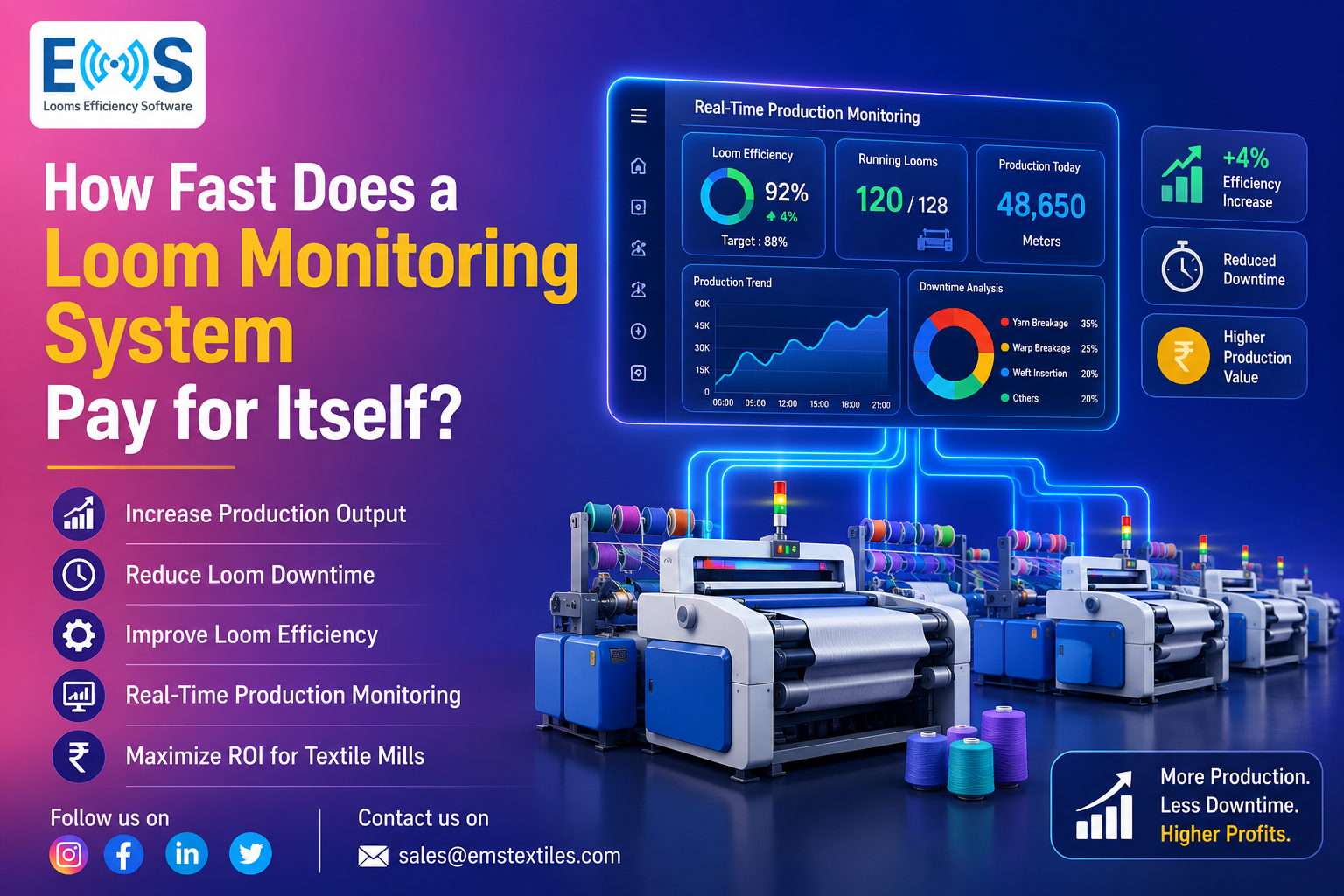
For textile mill owners, every investment must justify its cost. When considering a Loom Monitoring System, the question isn't just "How much does it cost?" but rather "How quickly will we get our money back?"
Many weaving factories operate under the assumption that manual tracking is "free" and digital systems are an extra expense. In reality, manual tracking hides massive losses in operator response times, untracked downtime, and slow decisions. Here is how a digital loom monitoring system like EMS delivers a high Return on Investment (ROI) and how quickly you can expect to break even.
Where the ROI Comes From
A loom monitoring system doesn't just display numbers on a screen; it directly affects the factory floor by eliminating inefficiency. Here are the four primary areas where the system recovers its initial cost:
1. Downtime Reduction
Every minute a loom is stopped, you lose production. In a manual setup, a machine might stand idle for 15-20 minutes before a supervisor notices, determines the cause, and calls a technician. Real-time monitoring triggers instant alerts for stopped looms, reducing average response times by up to 50%.
2. Increased Operator Accountability
By tracking operator-wise efficiency and stoppage response times, the shop floor becomes more disciplined. Operators are motivated when their performance is measured accurately and fairly, leading to a natural boost in daily productivity.
3. Prevention of Yarn and Fabric Defects
Continuous warp or weft stops that aren't addressed quickly can result in fabric defects. Real-time quality tracking alerts supervisors to repeated faults on specific looms, allowing them to fix the underlying mechanical issues before producing yards of defective fabric.
| Operational Leak | Manual Tracking Cost | Loom Monitoring (EMS) Impact |
|---|---|---|
| Stoppage Visibility | Delayed (Supervisor round every 30 mins) | Instant (Live Dashboard & SMS/App Alerts) |
| Downtime Root Cause | Approximated on paper logs at shift end | 100% accurate system-captured codes |
| Operator Speed | No tracking of individual response times | Leaderboards and response time tracking |
| Average Efficiency Gain | Baseline (65% - 72%) | Targeted Improvement (80% - 85%+) |
Calculating the Payback Period (Example Case Study)
Let's look at the financial impact for a mid-sized Indian weaving mill running 100 Rapier/Air Jet Looms:
Baseline Statistics:
� Daily Production: 10,000 meters (at average 70% efficiency)
� Average Fabric Selling Price: ?60 per meter
� Daily Revenue: ?6,00,000
By implementing a Loom Monitoring System, the mill achieves a conservative 5% efficiency increase (moving from 70% to 75%):
- New Daily Production: 10,714 meters (an extra 714 meters/day)
- Additional Daily Revenue: 714 meters � ?60 = ?42,840 per day
- Additional Monthly Revenue (26 days): ?42,840 � 26 = ?11,13,840 per month
Considering the software installation, hardware sensors, and training costs, a 100-loom mill recovers its entire initial capital investment within 2 to 3 months. After this short payback period, the increased efficiency translates directly into pure operational profit.
Practical Tip: Start by installing the monitoring system on a single section or line of 20 looms. Measure the efficiency improvement over 30 days, compare it with your manual sheets, and use the extra revenue generated to fund the rollout for the rest of your weaving factory.
Conclusion
A Loom Monitoring System is not a cost; it is an efficiency engine. In an industry with tight margins like textile manufacturing, a 5% to 10% efficiency gain is the difference between struggling to compete and running a highly profitable mill.
Plugging your floor's operational leaks today
Ready to see how EMS can transform your weaving factory's productivity? Book a live demo with our engineers and get a custom ROI estimate based on your loom models and current efficiency levels.
Book Your Free DemoReady to Transform Your Weaving Operations?
Book a free demo and see how EMS monitoring software can turn live loom data into faster decisions and measurable ROI.
Book a Free Demo