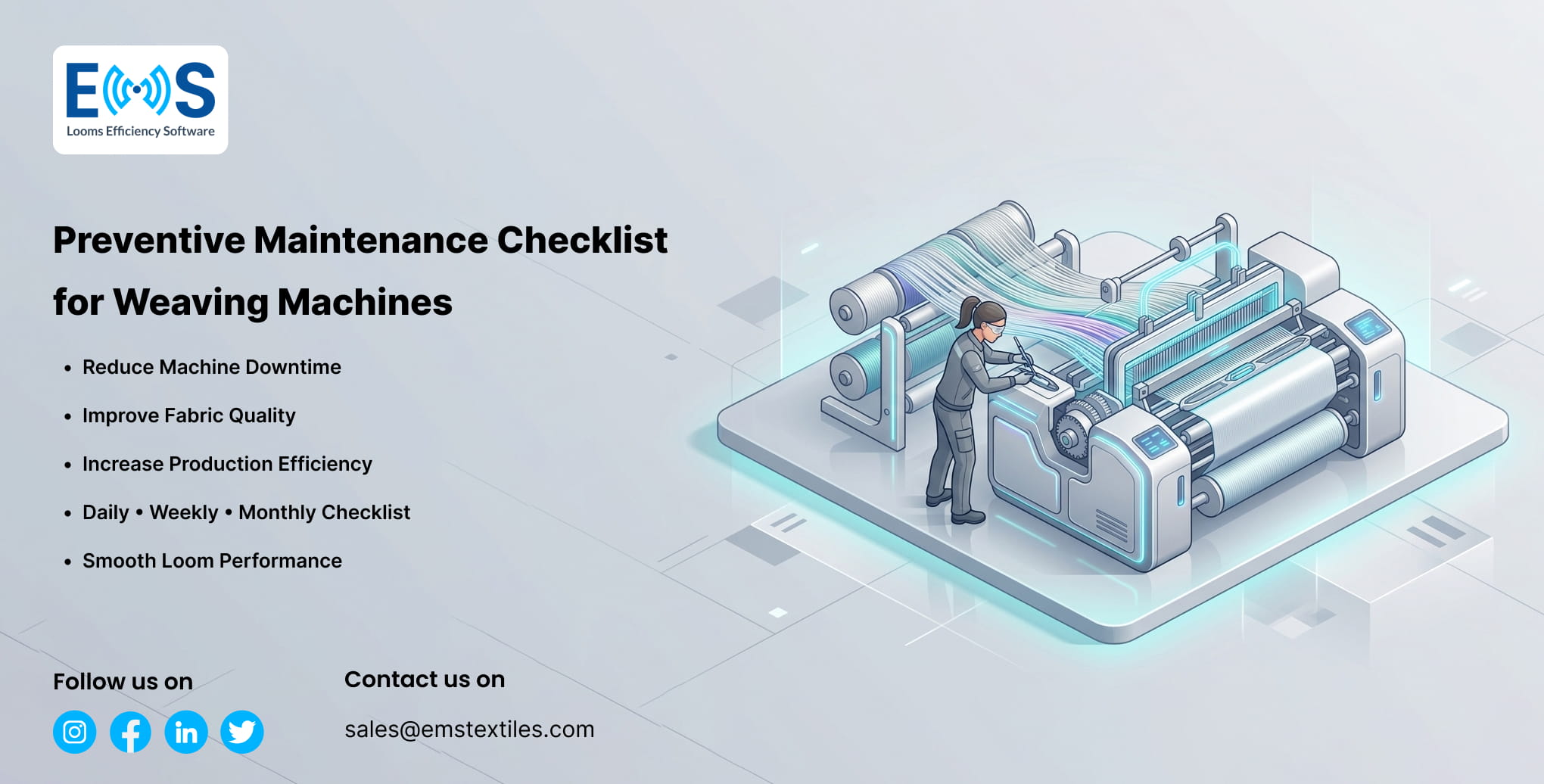
In a weaving factory, machines run for long hours under continuous load. If maintenance is ignored until breakdown, the factory loses production time, pays higher repair costs, and faces quality problems. Preventive maintenance keeps weaving machines healthy before failures happen.
What Is Preventive Maintenance?
Preventive maintenance means checking, cleaning, lubricating, adjusting, and servicing machines at planned intervals. The goal is to avoid sudden breakdowns, reduce downtime, and maintain stable production.
Why Preventive Maintenance Matters
- Reduces unplanned machine stoppages.
- Improves loom efficiency and production output.
- Extends machine and spare part life.
- Improves fabric quality and reduces defects.
- Helps supervisors plan work instead of reacting to emergencies.
Daily Maintenance Checklist
- Clean lint, dust, and waste around the loom.
- Check lubrication points and oil level.
- Inspect yarn path, warp, and weft areas.
- Check warp stop motion and weft stop motion.
- Look for oil leakage, unusual noise, and vibration.
- Verify safety guards and emergency stop function.
- Record stoppages that repeat during the shift.
Weekly Maintenance Checklist
- Check belts, pulleys, gears, and mechanical movement.
- Inspect electrical connections and control panels.
- Clean sensors, switches, and machine contact points.
- Check reed, heald frame, and shedding parts.
- Remove accumulated waste from hard-to-reach machine areas.
- Review breakdown history and production loss data.
Monthly Maintenance Checklist
- Complete major lubrication according to machine schedule.
- Check machine alignment and foundation condition.
- Inspect motor, bearings, and gearbox performance.
- Verify electronic panels, cables, and sensor accuracy.
- Check air pressure or water-related systems where applicable.
- Plan replacement of worn parts before failure.
- Review machine-wise maintenance and efficiency history.
Maintenance Checklist Summary
| Frequency | Main Focus | Expected Benefit |
|---|---|---|
| Daily | Cleaning, oil, yarn path, basic safety | Fewer small stoppages |
| Weekly | Mechanical, electrical, sensor checks | Early fault detection |
| Monthly | Major inspection and planned replacement | Longer machine life |
Signs a Machine Needs Attention
- Repeated stoppages on the same loom.
- Unusual noise, vibration, or heating.
- Frequent yarn breaks or fabric defects.
- Oil leakage or lubrication issues.
- Sudden drop in loom efficiency.
Common Maintenance Mistakes
- Waiting until a breakdown happens.
- Recording maintenance on paper but not verifying it.
- Ignoring repeated small stoppages.
- Not assigning clear responsibility.
- Not using production data to decide maintenance priority.
How EMS Helps Maintenance Teams
EMS gives machine-wise performance, downtime, and stoppage reports. Maintenance teams can see which looms stop frequently, which reasons repeat, and where preventive action is needed. This makes maintenance planning data-driven and practical.
Reduce surprise breakdowns.
Use EMS to track machine performance, identify recurring stoppages, and plan preventive maintenance with live factory data.
Ready to Transform Your Weaving Operations?
Book a free demo and see how EMS monitoring software can turn live loom data into faster decisions and measurable ROI.
Book a Free Demo