How Air Jet Loom Machines Are Revolutionizing High-Speed Textile Production in India
The Indian textile industry, a cornerstone of our economy, is constantly evolving. To stay competitive in the global market, textile mills in Surat, Ahmedabad, and across the nation are always seeking technologies that deliver higher output, better quality, and improved efficiency. Among these innovations, Air Jet Loom machines stand out as true game-changers, transforming the landscape of high-speed textile production.
For textile manufacturers aiming to maximize production capacity and produce defect-free fabrics, understanding the power of air jet looms is crucial. These machines represent a significant leap forward from traditional weaving methods, offering unmatched speed and precision. Let's delve into how air jet looms are not just machines, but a strategic advantage for modern textile mills.
The Core of Speed: Understanding Air Jet Loom Working Principles
At the heart of an air jet loom's remarkable speed lies its innovative weft insertion mechanism. Unlike conventional looms that use shuttles or mechanical grippers, air jet looms utilize a powerful, controlled blast of air to propel the weft yarn across the warp shed. This high-velocity air stream dramatically reduces the time required for weft insertion, leading to significantly faster weaving cycles.
The process begins with the main nozzle, which initiates the weft insertion by sending a pulse of compressed air. This air carries the yarn partway across the loom. To ensure the yarn reaches the other side smoothly and without excessive tension, a series of precisely timed relay nozzles (also known as sub-nozzles or auxiliary nozzles) are strategically placed across the loom's width. These relay nozzles provide continuous boosts of air, guiding the weft yarn accurately and consistently. The precise coordination of these nozzles, coupled with advanced electronic controls, ensures uniform weft tension and prevents yarn breakage, which is vital for maintaining high speeds and fabric quality.
Key Components that Drive Efficiency:
- Main Nozzle: The primary air jet that injects the weft yarn into the shed.
- Relay Nozzles: Auxiliary jets that assist in propelling the weft yarn across the entire width of the loom.
- Measuring and Accumulating Device: Precisely measures and prepares the exact length of weft yarn needed for each pick, minimizing waste.
- Air Compressor System: Provides the high-pressure air essential for weft insertion. Efficient compressors are critical for energy management.
- Shedding Mechanism: Modern air jet looms often use dobby or jacquard mechanisms for complex patterns, controlled electronically for speed and precision.
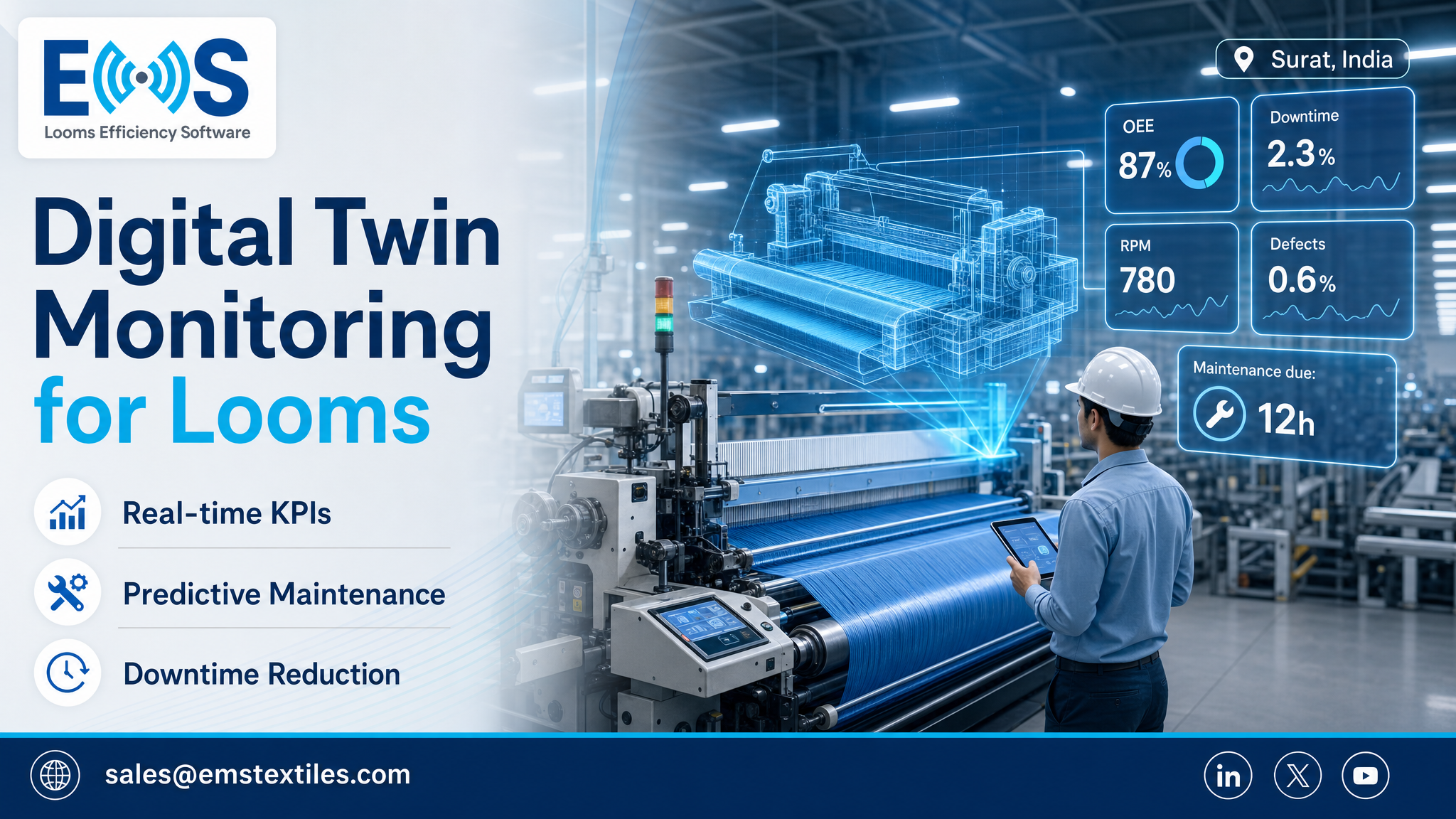
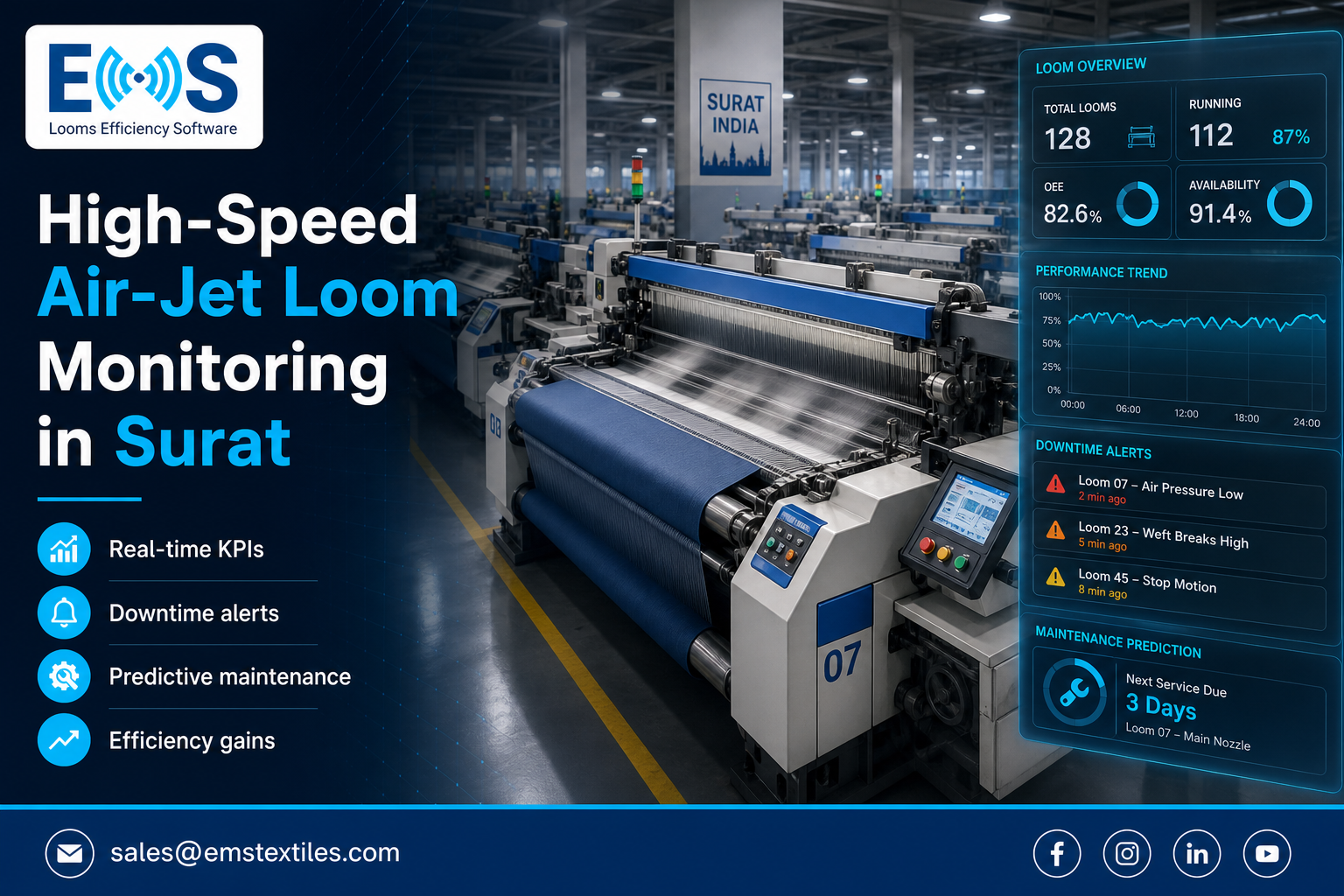
- Electronic Control Unit: Manages all machine functions, timing, and fault detection, often integrating with monitoring software like EMS Textiles' solutions for real-time insights.
Unmatched Efficiency: Production Speed, Quality, and Energy Savings
The adoption of air jet looms brings a multitude of benefits that directly impact a textile mill's bottom line and competitive standing:
1. Phenomenal Production Speed
Air jet looms are synonymous with speed. They can operate at speeds ranging from 600 to 1200 Picks Per Minute (PPM), and even higher in some advanced models, far surpassing traditional shuttle and rapier looms. This means significantly higher output per machine, translating to increased fabric production capacity without necessarily expanding the factory footprint. For busy Indian mills, this translates to meeting larger orders and shorter delivery times, enhancing market responsiveness.
2. Superior Fabric Quality
The gentle, precise weft insertion mechanism of air jet looms minimizes yarn stress and friction, leading to fewer yarn breakages and defects. This results in high-quality, uniform fabric with consistent weave density and minimal weaving faults. The reduced need for manual intervention also lowers the chances of human error impacting quality, making them ideal for producing fine and delicate fabrics as well as industrial textiles.
3. Optimized Energy Consumption
While air jet looms require compressed air, advancements in nozzle design, compressor technology, and intelligent control systems have made them increasingly energy-efficient. Modern air jet looms are designed to optimize air usage, reducing overall energy consumption per meter of fabric produced compared to older generations. Coupled with continuous monitoring solutions from companies like EMS Textiles, mills can precisely track and manage energy usage, identifying areas for further optimization and cost reduction.
4. Reduced Maintenance and Downtime
With fewer moving parts compared to mechanical weft insertion systems, air jet looms generally require less maintenance. The absence of heavy, reciprocating parts also leads to reduced wear and tear, prolonging machine life. When maintenance is needed, their modular design often allows for quicker part replacement. Integrating an advanced machine monitoring system from EMS Textiles can further enhance this by providing predictive maintenance alerts, minimizing unexpected breakdowns, and maximizing uptime.
Practical Tip for Mill Owners:
To truly leverage the efficiency of air jet looms, regular monitoring of key performance indicators (KPIs) like Efficiency (Overall Equipment Effectiveness), yarn breakage rates, and energy consumption per meter is essential. Tools like EMS Textiles� software can provide these real-time insights, helping you make data-driven decisions for maximum productivity.
Air Jet Looms vs. Other Weaving Technologies: A Comparative Edge
Understanding where air jet looms stand in comparison to other prevalent weaving technologies helps in making informed investment decisions. Each loom type has its niche, but for high-speed, high-volume production of a wide range of fabrics, air jet looms often lead the pack.
| Feature | Air Jet Loom | Rapier Loom | Water Jet Loom | Shuttle Loom (Traditional) |
|---|---|---|---|---|
| Weft Insertion | Compressed Air | Rigid/Flexible Rapier Grippers | High-Pressure Water Jet | Shuttle with Pirn |
| Max. Speed (PPM) | 600 - 1200+ | 400 - 800 | 800 - 1500+ | 100 - 200 |
| Fabric Range | Wide (light to medium-heavy, denim, shirting, industrial) | Very Wide (heavy denim, upholstery, complex patterns, delicate) | Limited (hydrophobic synthetic fibers like nylon, polyester) | Limited (coarse to medium, specialized applications) |
| Energy Consumption | Medium (for air compressor), efficient per meter | Medium-High (mechanical complexity) | High (for water pump & drying) | Low (but very low output) |
| Maintenance | Moderate (fewer moving parts, but complex air system) | High (many moving mechanical parts) | Moderate (water treatment, drying) | Moderate (frequent adjustments) |
| Noise Level | Moderate (from air jets & compressor) | Moderate-High (mechanical components) | Low (water damping) | Very High |
| Capital Cost | High | Medium-High | Medium | Low |
As evident, while water jet looms can achieve comparable or even higher speeds, their application is limited to synthetic fibers due to the need for water-resistant yarns and drying. Rapier looms offer incredible versatility but generally at lower speeds. For the diverse and high-volume demands of the Indian textile market, air jet looms provide an optimal balance of speed, versatility, and efficiency for a broad spectrum of fabrics.
Real-World Impact and Future Horizons for Indian Mills
The impact of air jet looms is visible across various segments of the Indian textile industry. From large-scale denim manufacturers in Ahmedabad to shirting fabric producers in Surat, these machines are enabling mills to:
- Boost Production Output: Meet growing demand for exports and domestic markets.
- Enhance Product Diversification: Weave a wider variety of fabrics with consistent quality.
- Improve Cost-Efficiency: Lower per-meter production costs through speed and reduced waste.
- Strengthen Competitiveness: Offer faster turnaround times and superior products.
Looking ahead, the future of air jet looms lies in even greater automation and intelligent integration. Expect to see:
- Smarter Controls: Enhanced AI and machine learning for predictive maintenance, automatic defect detection, and self-optimization.
- Increased Weaving Widths and Speeds: Pushing the boundaries of productivity.
- Advanced Yarn Handling: Improved systems for handling an even wider range of yarn types and counts.
- Seamless Integration with Industry 4.0: Connecting looms to a central data hub for comprehensive factory management.
This is where companies like EMS Textiles play a pivotal role. Our machine monitoring and loom efficiency software are designed to unlock the full potential of advanced weaving technologies like air jet looms. By providing real-time data on loom performance, Efficiency, energy consumption, and fault diagnostics, EMS solutions empower mill owners to make informed decisions, optimize operations, reduce downtime, and drive profitability. Imagine knowing exactly which loom needs attention, why production is slowing, or how much energy each machine consumes, all at your fingertips. This level of insight is crucial for navigating the complexities of modern textile manufacturing.
Maximizing Your Air Jet Loom Investment: A Checklist
To ensure you're getting the most out of your high-speed air jet looms, consider the following practical steps:
- Regular & Preventive Maintenance: Adhere strictly to manufacturer's maintenance schedules. Pay close attention to air compressor health and nozzle cleanliness.
- Optimized Yarn Preparation: Ensure yarn quality and proper winding to minimize breakages at high speeds.
- Skilled Workforce Training: Invest in training your operators and technicians on the specific nuances of air jet loom operation and troubleshooting.
- Implement Machine Monitoring: Utilize a robust system like EMS Textiles' software to track Efficiency, downtime, fault codes, and energy usage in real-time.
- Data-Driven Decision Making: Use the insights from your monitoring system to identify bottlenecks, optimize settings, and streamline production processes.
- Maintain Optimal Environmental Conditions: Control humidity and temperature to ensure consistent yarn behavior and machine performance.
Ready to revolutionize your textile production with enhanced loom efficiency? Contact EMS Textiles today to learn how our machine monitoring solutions can elevate your air jet loom performance and boost your mill's profitability.
Ready to Transform Your Weaving Operations?
Book a free demo and see how EMS monitoring software can turn live loom data into faster decisions and measurable ROI.
Book a Free Demo